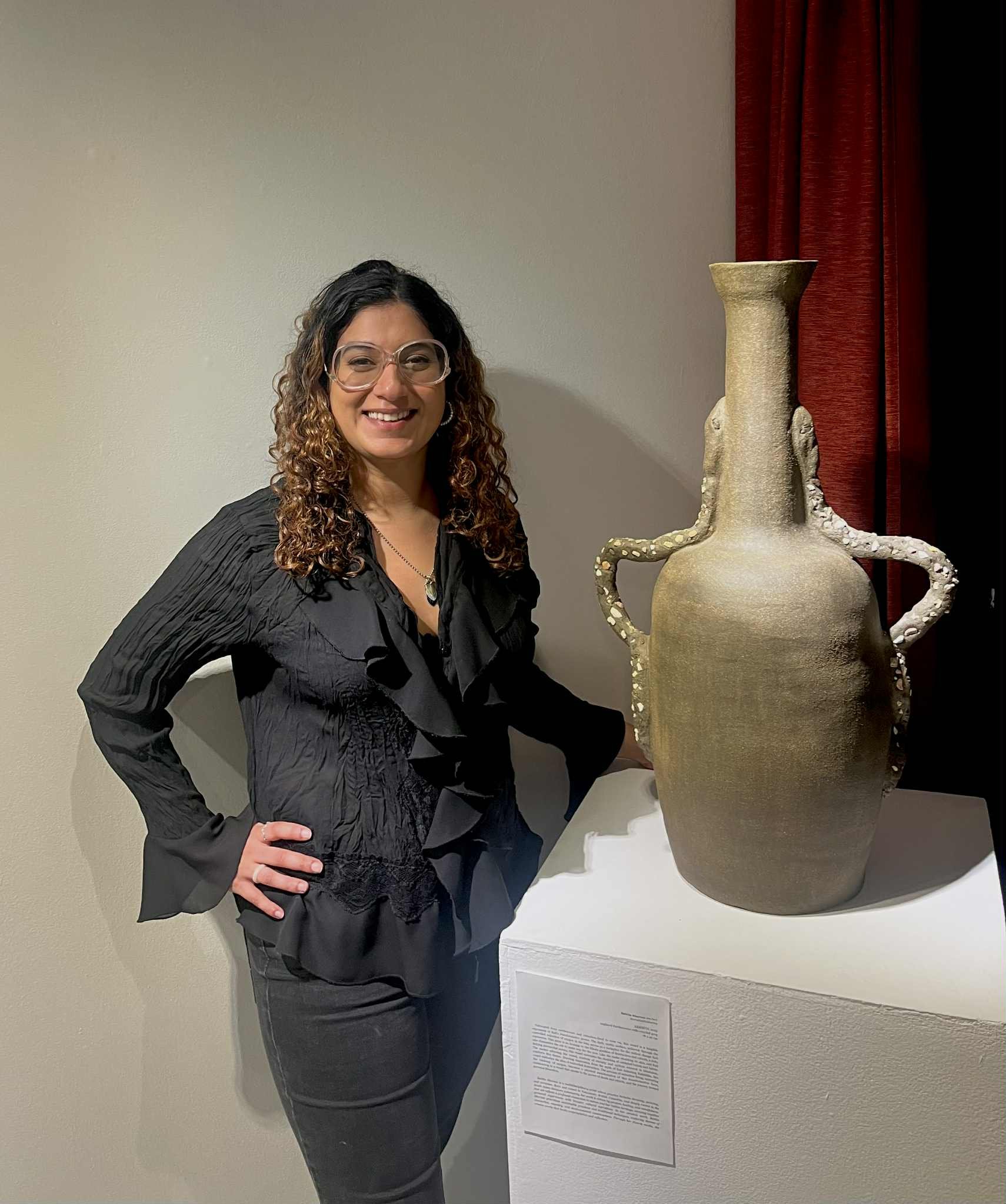
Babita Sharma (b. 1991) is a multidisciplinary artist and curator of the South Asian diasporic community. Originally from K’emk’emeláy (Vancouver), she currently resides in Tiohtiá:ke (Montreal). Her artistic practice works primarily in mixed media and ceramics.Deeply committed to community-building and systemic change, Sharma views curation as a vital tool for empowerment. In 2018 and 2020, she curated WOC and In Her Own Image, initiatives designed to uplift women of color while exploring spiritual and cultural narratives. A recipient of a 2022 Canada Council for the Arts research grant, her work is informed by ongoing research into diasporic themes. Her practice is shaped by a global perspective, including past residencies in Argentina and an upcoming residency in Mumbai. She is currently completing her BFA at Concordia University and has recently exhibited at Galerie Erga, Galerie 1040, and Atelier Galerie 2112.
Artist Biography
As a first-generation Canadian and child of Punjabi immigrants, my practice emerges from my lived experiences as a women of color moving between cultural, spiritual, and emotional worlds. Existing within the diaspora has shaped my relationship to identity as something fluid and layered, rather than fixed. Art becomes both a refuge and a language through which I process this in-between state, translating duality, memory, and longing into form.My multidisciplinary practice spans abstract mixed media paintings and ceramics, each offering a distinct yet interconnected way of engaging with the subconscious. Through soothing, calming colour palettes, layered acrylics, paper, and oil pastel linework, I use mixed media as a space to hold complex emotions that resist literal representation. The slow accumulation of layers mirrors the gradual nature of healing, allowing meaning to emerge through repetition, erasure, and transformation.In parallel, my ceramic practice draws from eastern spirituality, channeling symbolic forms and objects that reference myth, ritual, and memory. These works reinterpret cultural signifiers in unconventional ways, allowing tradition to remain alive through reimagining rather than preservation alone. Instead of revisiting trauma as an endpoint, my work is rooted in restoration. I am interested in empathy as a tool for emotional release and spiritual reconnection—both with the self and with something larger and unseen. Across mediums, my practice is a negotiation between past and present, material and spirit, personal history and collective experience—an ongoing search for belonging through making.